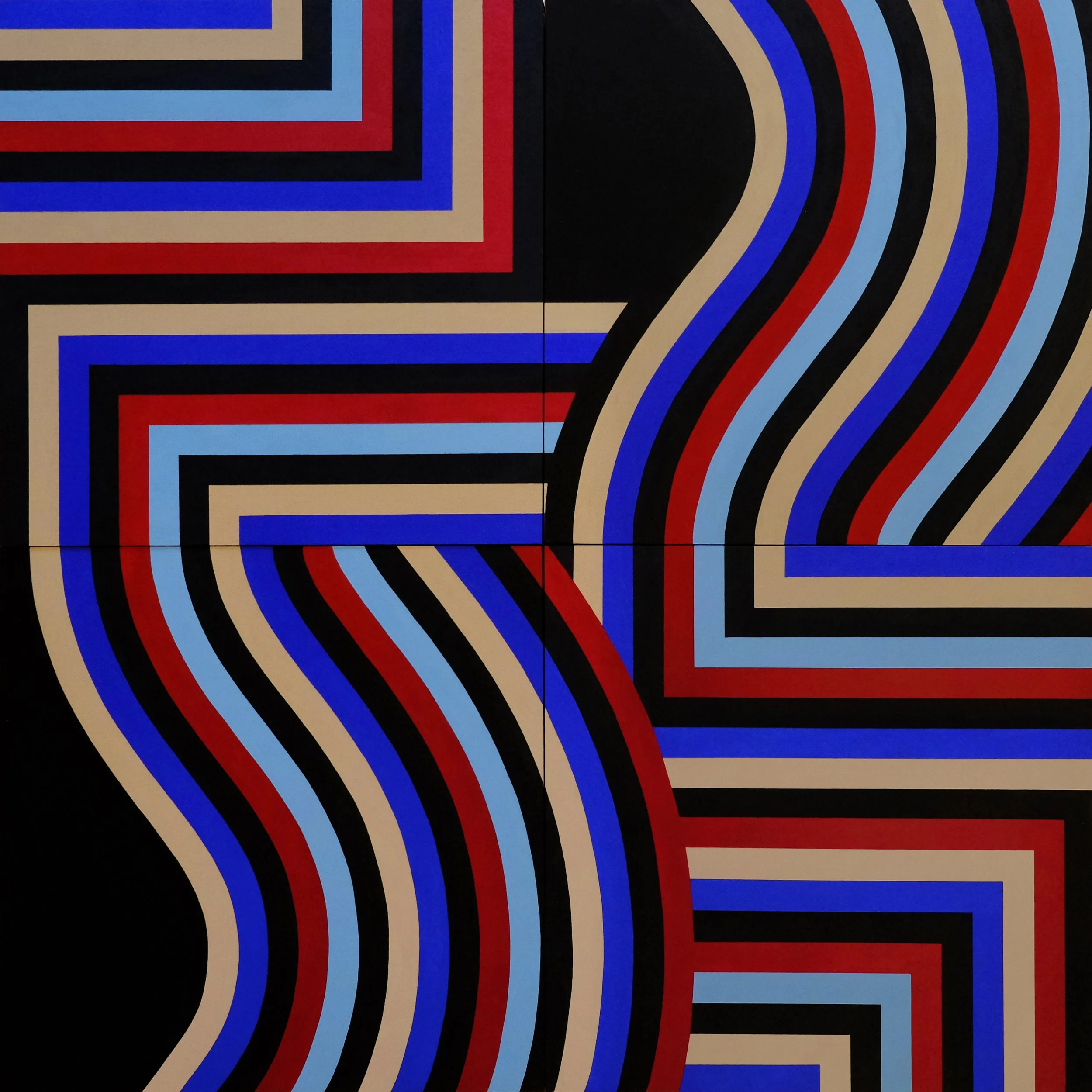
Artist Statement
The thread that runs across my work is a search for balance between familiarity and novelty. Throughout my life, I have been drawn to constancy and repetition as a way of making sense of rupture, while at the same time craving change once predictability settled in. My work reflects this tension – a desire to create environments where familiarity and disruption can coexist in varying proportions.
What unfolds visually in the work is also, in many ways, psychological. A phrase that stayed with me from my studies in psychology is that “humans are cognitive misers.” Our brains seek efficiency, relying on patterns to navigate and interpret the complexity of the world. Pattern, for me, is both a conceptual anchor and a visual language – something that can be followed, manipulated, stretched, or broken. My painting and textile practices operate as parallel approaches to this idea. Both begin from structured patterns that are gradually transformed, allowing for different degrees of control, distortion, and intuition.
I often think about art as the point where intention gives way to instinct. In my process, I begin with structured patterns and gradually allow intuition to reshape them. I also understand identity in a similar way – as partly consciously formed, and partly emerging beyond intention. More broadly, I think about perception as something constructed through attention, emotion, and time, rather than as a fixed reality. Across all of this runs the same tension between structure and freedom: the systems and patterns we internalize, and our ongoing resistance to them in search of individual expression.
My work is also deeply connected to a sense of uprootedness that shaped my childhood. Growing up between countries meant repeatedly leaving behind places, people, and attachments, and never fully identifying with any one culture. I often felt suspended between identities – shaped by Brazilian origins, a French educational upbringing, and constant movement across places, without ever fully belonging to one. Language itself felt elusive, shaped by a distance between thought and articulation that never fully closed. In many ways, I came to understand myself through the experience of never fully fitting into singular definitions. My identity always lived in the spaces between categories. Art became a space where ambiguity did not need to be resolved or justified.
In the act of making, I am able to hold these contradictions without needing to reconcile them. The work becomes a space where opposing impulses can coexist – control and surrender, repetition and disruption, belonging and displacement – not as problems to solve, but as conditions to move through.